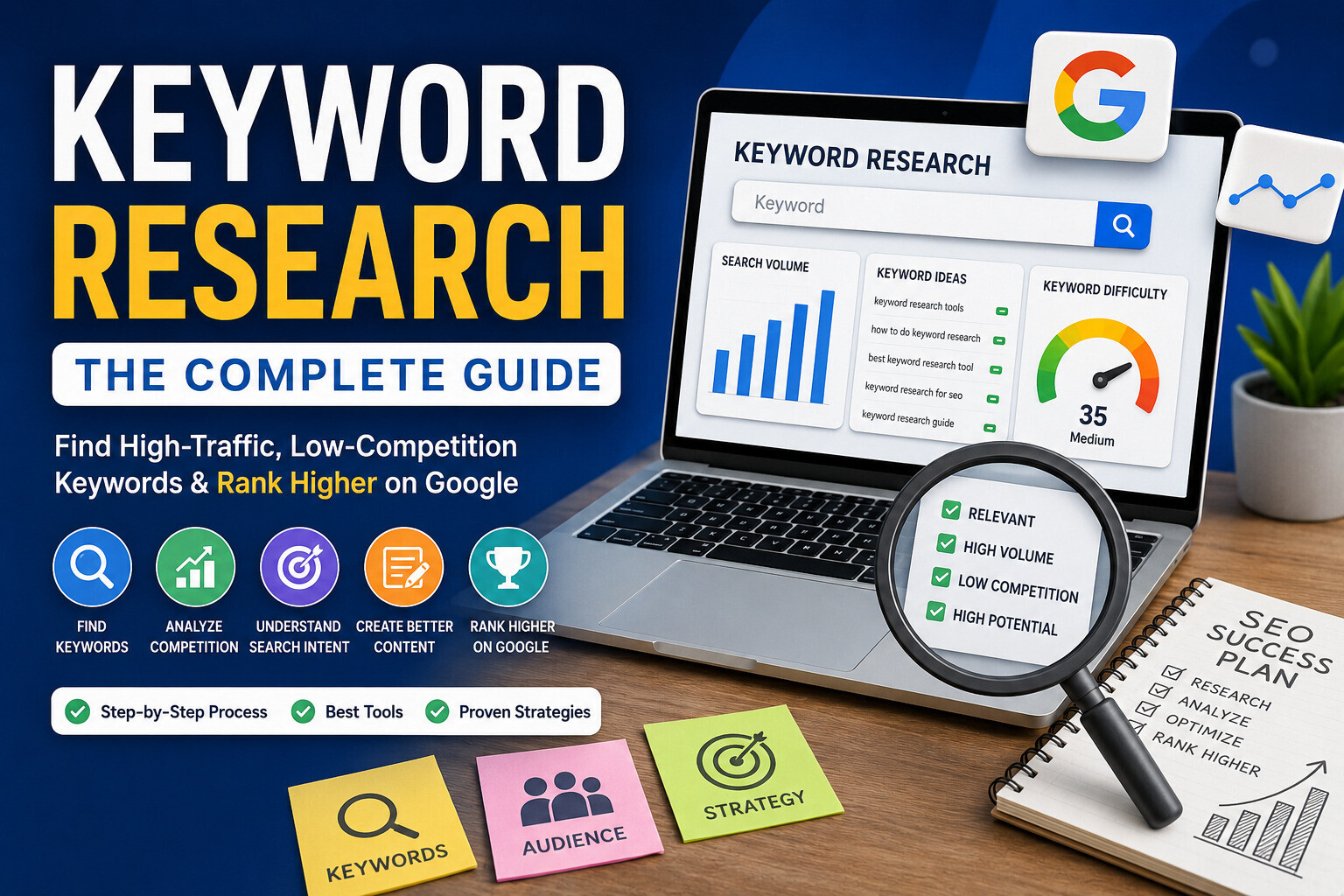
Keyword Research: The Complete Beginner’s Guide
Keyword research is the foundation of every successful SEO strategy. Whether you’re running a blog, an eCommerce store, a business website, or a niche affiliate site, choosing the right keywords helps you attract the right audience and improve your visibility in search engines.
Publishing high-quality content is important, but without targeting the terms people are actually searching for, even excellent articles may struggle to gain organic traffic.
In this comprehensive guide, you’ll learn what keyword research is, why it matters, the different types of keywords, how search intent works, and a step-by-step process for finding valuable keyword opportunities.
Whether you’re a beginner or an experienced content creator, these strategies will help you build a stronger SEO foundation.
What Is Keyword Research?
Keyword research is the process of discovering the words and phrases that people enter into search engines when looking for information, products, or services.
The goal is to identify keywords that are:
- Relevant to your topic
- Frequently searched
- Appropriate for your audience
- Realistic to rank for
- Valuable to your business or content goals
Instead of guessing what people search for, keyword research uses data to guide content creation.
Why Keyword Research Is Important
Keyword research supports almost every aspect of search engine optimization.
Better Organic Traffic
Targeting relevant search terms increases the likelihood that your content appears in search results for people actively looking for your topic.
Understanding User Needs
Keywords provide insight into what users want to know, compare, or purchase. This helps you create content that aligns with their goals.
Stronger Content Strategy
Researching keywords allows you to plan content around real search demand rather than assumptions.
Improved Conversion Potential
Visitors who arrive through highly relevant searches are often more likely to engage with your content or take meaningful actions, such as subscribing or making a purchase.
Competitive Advantage
Analyzing keywords can reveal topics your competitors rank for, as well as opportunities where high-quality content may perform well.
How Search Engines Use Keywords
Search engines analyze many signals to understand and rank content.
Keywords help indicate:
- The primary topic of a page
- User intent
- Content relevance
- Relationships between concepts
Modern search engines also consider context, synonyms, topical authority, content quality, page experience, and many other ranking signals.
This means successful SEO is no longer about repeating keywords—it is about creating comprehensive, useful content that satisfies search intent.
Types of Keywords
Understanding keyword categories helps you build a balanced SEO strategy.
Short-Tail Keywords
These are broad search terms, usually consisting of one or two words.
Examples:
- SEO
- Laptop
- Insurance
- WordPress
Advantages
- High search volume
- Broad audience
Challenges
- Very competitive
- User intent may be unclear
Long-Tail Keywords
Long-tail keywords are longer, more specific phrases.
Examples:
- Best AI writing tools for bloggers
- Affordable gaming laptop under $1000
- Beginner’s guide to keyword research
Advantages
- Lower competition
- Clearer search intent
- Higher conversion potential
- Easier to rank for in many niches
Informational Keywords
Users are looking for knowledge or answers.
Examples:
- What is keyword research?
- How does SEO work?
- How to install WordPress
These keywords are excellent for blog posts, tutorials, and educational content.
Navigational Keywords
The user wants to reach a specific website, brand, or page.
Examples:
- Google Search Console
- WordPress login
- FreelancerHelps
Commercial Investigation Keywords
The user is researching options before making a decision.
Examples:
- Best AI resume builder
- Rank Math vs Yoast SEO
- Best laptops for programming
These keywords are valuable for comparison articles and product reviews.
Transactional Keywords
Users are ready to take action, such as purchasing or signing up.
Examples:
- Buy wireless keyboard
- Download SEO checklist
- Start free AI writing tool
These keywords often have strong conversion potential.
Understanding Search Intent
Search intent refers to the reason behind a user’s search.
Matching your content to search intent is one of the most important aspects of SEO.
Informational Intent
The user wants to learn something.
Examples:
- What is digital marketing?
- How to create a website
Best content types:
- Tutorials
- Guides
- Blog posts
- Educational articles
Navigational Intent
The user wants a specific destination.
Examples:
- YouTube
- Gmail
- Google Docs
Best content:
- Official pages
- Brand-specific information
Commercial Intent
The user is comparing products or services before making a decision.
Examples:
- Best AI coding assistants
- Best WordPress themes
- Best AI image generators
Best content:
- Comparison articles
- Reviews
- Buying guides
Transactional Intent
The user is ready to complete an action.
Examples:
- Buy web hosting
- Download resume template
- Subscribe to SEO course
Best content:
- Product pages
- Service pages
- Landing pages
Step-by-Step Keyword Research Process
A structured process helps you identify keywords that match your audience and content goals.
Step 1: Identify Your Niche
Clearly define your primary topic.
Examples:
- SEO
- WordPress
- Artificial Intelligence
- Freelancing
- Digital Marketing
Step 2: Brainstorm Seed Keywords
Seed keywords are broad ideas that describe your niche.
Example for AI:
- AI writing
- AI coding
- AI image generation
- AI video generation
- AI chatbot
These serve as starting points for discovering more specific keyword opportunities.
Step 3: Expand Your Keyword List
Use keyword research tools to identify:
- Related searches
- Long-tail keywords
- Frequently asked questions
- Keyword variations
- Topic clusters
Build a comprehensive list before deciding which keywords to target.
Step 4: Analyze Search Intent
Ask:
- What is the user trying to accomplish?
- What type of content currently ranks?
- Can my content satisfy that need better?
Search intent should guide your content structure and depth.
Step 5: Evaluate Keyword Difficulty
Consider:
- Competition level
- Authority of ranking websites
- Quality of existing content
- Your website’s topical authority
Newer websites often benefit from targeting lower-competition, long-tail keywords before pursuing highly competitive terms.
Step 6: Prioritize Keywords
Choose keywords based on:
- Relevance
- Search intent
- Ranking difficulty
- Business value
- Content opportunities
Not every keyword with high search volume is the best choice.
Tips for Better Keyword Research
To improve your keyword selection:
- Focus on solving user problems.
- Target one primary keyword per page.
- Include closely related terms naturally.
- Build topical authority with supporting articles.
- Review and update your keyword strategy regularly.
- Prioritize quality over quantity.
These advanced techniques will help you discover stronger keyword opportunities and build a more effective long-term SEO strategy.
Best Free Keyword Research Tools
You don’t need an expensive subscription to start finding valuable keywords. Several free tools provide useful insights into search behavior, keyword ideas, and content opportunities.
1. Google Keyword Planner
Best For: Finding keyword ideas and estimating search demand.
Key Features
- Keyword suggestions
- Search volume ranges
- Competition estimates
- Geographic targeting
- Related keyword ideas
Pros
- Free with a Google Ads account
- Data directly from Google
- Good for beginners
Limitations
- Search volumes are often shown as ranges unless you’re actively using Google Ads.
2. Google Search Autocomplete
Google’s autocomplete suggestions reflect common user searches and can inspire long-tail keyword ideas.
Example:
Typing:
Keyword Research
may reveal suggestions such as:
- Keyword research tools
- Keyword research for SEO
- Keyword research guide
- Keyword research checklist
These suggestions are especially useful for discovering informational search intent.
3. Google “People Also Ask”
The People Also Ask (PAA) section highlights common questions related to a topic.
Examples:
- What is keyword research?
- Why is keyword research important?
- Which keyword tool is best?
- How do beginners find keywords?
These questions are excellent candidates for FAQ sections and supporting content.
4. Google Related Searches
At the bottom of many search result pages, Google displays related searches that can help identify additional keyword opportunities and semantic relationships.
5. Google Search Console
If your website is already receiving traffic, Google Search Console can help you discover:
- Queries your pages appear for
- Click-through rates (CTR)
- Average ranking positions
- High-impression keywords
- Opportunities to improve existing pages
It is one of the most valuable tools for optimizing content you have already published.
Best Paid Keyword Research Tools
Premium tools typically offer more comprehensive data and competitive analysis features.
1. Ahrefs
Best For
Professional SEO campaigns and competitor research.
Features
- Keyword Explorer
- Keyword Difficulty (KD)
- Traffic estimates
- Backlink analysis
- Competitor research
- Content gap analysis
Advantages
- Extensive keyword database
- Strong backlink data
- Excellent competitive insights
2. Semrush
Best For
All-in-one SEO and digital marketing.
Features
- Keyword Magic Tool
- Position tracking
- Site audits
- Competitor analysis
- PPC research
- Content optimization
Advantages
- Comprehensive marketing toolkit
- Large keyword database
- Powerful reporting features
3. Moz Keyword Explorer
Features
- Keyword suggestions
- Difficulty scores
- Opportunity metrics
- SERP analysis
- Priority scoring
Suitable for marketers looking for a balanced keyword evaluation workflow.
4. Ubersuggest
Features
- Keyword ideas
- SEO difficulty
- Domain analysis
- Content suggestions
- Traffic estimates
A user-friendly option for bloggers, freelancers, and small businesses.
5. KeywordTool.io
Features
- Long-tail keyword suggestions
- Question-based keywords
- Multi-platform research
- Google, YouTube, Bing, Amazon support
Useful for expanding keyword lists across different search platforms.
How to Find Low-Competition Keywords
Low-competition keywords are often easier to rank for, especially if your website is relatively new.
Look for Long-Tail Keywords
Instead of targeting:
AI Tools
Consider:
Best AI writing tools for students
or
AI image generator for blog featured images
Long-tail phrases often have clearer intent and lower competition.
Analyze the Search Results
Review the current search results for your target keyword.
Ask yourself:
- Are authoritative websites dominating the page?
- Are there opportunities to provide more complete or updated content?
- Is the existing content meeting user intent effectively?
Target Question-Based Keywords
Examples:
- How does keyword research work?
- What are long-tail keywords?
- Which keyword research tool is best for beginners?
Question-based content can align well with informational search intent.
Focus on Topical Relevance
Publishing multiple high-quality articles around a subject can strengthen your topical authority.
For example, instead of one article about SEO, you might publish guides covering:
- Keyword Research
- On-Page SEO
- Technical SEO
- Link Building
- Internal Linking
- SEO Audits
- Search Intent
- Content Optimization
Competitor Keyword Analysis
Analyzing competitors helps identify opportunities and content gaps.
Step 1
Identify websites that consistently rank for topics in your niche.
Step 2
Review:
- Their article titles
- Headings
- Frequently covered topics
- Internal linking structure
- Content depth
Step 3
Ask:
- Which important questions remain unanswered?
- Can I provide more current examples?
- Can I explain the topic more clearly?
- Can I improve readability and organization?
The goal is to create a more helpful resource rather than simply producing a longer article.
Long-Tail Keyword Strategy
Long-tail keywords often attract visitors with more specific needs.
Examples:
Broad Keyword
WordPress
Long-Tail Keyword
Best free WordPress themes for bloggers in 2026
Broad Keyword
Resume Builder
Long-Tail Keyword
Best AI resume builder for fresh graduates
Broad Keyword
AI Tools
Long-Tail Keyword
Best AI tools for small business marketing
A collection of related long-tail articles can help build topical authority over time.
Keyword Clustering
Keyword clustering groups closely related search terms into a single, comprehensive piece of content.
Instead of creating separate pages for every variation, combine naturally related keywords where appropriate.
Example Cluster
Primary Keyword:
- Keyword Research
Supporting Keywords:
- SEO keyword research
- Keyword analysis
- Long-tail keywords
- Search intent
- Keyword research tools
- Keyword difficulty
Covering related concepts together often provides a better user experience.
Building Topical Authority
Search engines increasingly evaluate websites based on overall expertise within a subject area.
A strong content hub for SEO might include articles such as:
- Keyword Research
- Technical SEO
- On-Page SEO
- Off-Page SEO
- Link Building
- SEO Audit Guide
- Content Marketing
- Google Search Console Guide
- Rank Math Tutorial
- Core Web Vitals
Internal links between these articles can help users navigate related topics and strengthen your site’s overall structure.
Common Keyword Research Mistakes
Avoid these frequent mistakes.
Targeting Only High-Volume Keywords
High search volume often means higher competition.
Balance search demand with relevance and ranking difficulty.
Ignoring Search Intent
Even a well-written article may underperform if it does not match what users expect to find.
Keyword Stuffing
Using the same keyword excessively can reduce readability and provide a poor user experience.
Write naturally and focus on helpful content.
Ignoring Existing Content
Review older articles regularly.
Updating and improving existing pages can often be more effective than creating entirely new ones.
Publishing Without a Strategy
Every article should have:
- One primary keyword
- Related supporting keywords
- Clear search intent
- Logical internal links
- A defined purpose
These final recommendations will help you apply keyword research effectively and build a sustainable long-term SEO strategy.
Keyword Research Checklist
Before creating a new article or landing page, review this checklist to ensure your keyword strategy is well planned.
- Choose one primary keyword.
- Identify 5–10 related secondary keywords.
- Understand the search intent behind the keyword.
- Review the current top-ranking pages.
- Evaluate keyword difficulty and competition.
- Look for long-tail keyword opportunities.
- Plan internal links to related content.
- Prepare descriptive image alt text.
- Write an SEO-friendly title and meta description.
- Create a logical heading structure (H1, H2, H3).
- Plan a compelling introduction and conclusion.
- Include a clear call to action where appropriate.
Following a consistent checklist can help improve both content quality and long-term SEO performance.
How to Use Keywords Naturally
Modern SEO is about relevance and readability—not repeating the same phrase.
Use Keywords in Important Locations
Include your primary keyword naturally in:
- Page title
- URL slug
- H1 heading
- Introduction
- At least one H2 heading (when appropriate)
- Meta title
- Meta description
- Image alt text
- Conclusion
Avoid forcing keywords where they don’t fit naturally.
Use Semantic Keywords
Search engines understand related concepts and synonyms.
Example:
Primary Keyword:
Keyword Research
Related terms:
- SEO keyword research
- Search intent
- Keyword analysis
- Long-tail keywords
- Keyword clustering
- Search volume
- Keyword difficulty
- Organic traffic
Using related terminology helps create more comprehensive content.
Prioritize Readability
Write for people first.
Good content should:
- Answer the user’s questions clearly.
- Flow naturally.
- Avoid unnecessary repetition.
- Provide practical examples.
- Be easy to scan with headings and lists.
Keyword Research for Different Website Types
Blogs
Blog content often performs well with informational keywords.
Examples:
- How to do keyword research
- Beginner’s guide to SEO
- What is search intent?
Focus on solving readers’ problems and answering common questions.
E-commerce Websites
Product and category pages often benefit from commercial and transactional keywords.
Examples:
- Buy wireless gaming mouse
- Best laptop for graphic design
- Affordable office chair
Support these pages with buying guides and comparison articles.
Local Businesses
Local SEO targets customers in a specific geographic area.
Examples:
- Best dentist in Chicago
- Coffee shop near Central Park
- Digital marketing agency in London
Location-specific keywords can help attract nearby customers.
Affiliate Websites
Affiliate sites often focus on comparison and review keywords.
Examples:
- Best AI writing tools
- Rank Math vs Yoast SEO
- Best WordPress hosting
- Best AI resume builders
These keywords align with users researching products before making decisions.
Keyword Research Workflow
A repeatable workflow makes keyword research more efficient.
Step 1
Identify your topic.
Step 2
Brainstorm seed keywords.
Step 3
Expand your list using keyword research tools.
Step 4
Analyze search intent.
Step 5
Review the search results and competitors.
Step 6
Evaluate keyword difficulty and business relevance.
Step 7
Create a content outline.
Step 8
Publish high-quality, user-focused content.
Step 9
Monitor rankings and performance using analytics tools.
Step 10
Update the content regularly to keep it accurate and useful.
Frequently Asked Questions
What is keyword research?
Keyword research is the process of identifying the search terms people use in search engines so you can create content that matches their interests and needs.
Why is keyword research important?
It helps you understand what your audience is searching for, improve content planning, and increase the chances of attracting relevant organic traffic.
What is a long-tail keyword?
A long-tail keyword is a more specific search phrase that typically has lower competition and clearer search intent.
Which keyword research tool is best?
The best tool depends on your goals and budget. Many beginners start with free options such as Google Keyword Planner and Google Search Console, while professionals often use premium SEO platforms for deeper analysis.
How many keywords should I target?
Generally, focus on one primary keyword per page, supported by several closely related secondary keywords used naturally throughout the content.
What is keyword difficulty?
Keyword difficulty estimates how competitive a keyword may be based on factors such as the strength of pages already ranking for that topic.
What is search intent?
Search intent is the reason behind a user’s search. Understanding whether someone wants information, comparisons, or to complete a purchase helps you create more relevant content.
Can I rank without high-volume keywords?
Yes. Many websites grow successfully by targeting long-tail keywords and building topical authority over time.
Should I repeat keywords many times?
No. Overusing keywords can reduce readability. Focus on writing naturally and covering the topic comprehensively.
How often should I perform keyword research?
Review your keyword strategy regularly, especially when publishing new content, entering a new niche, or updating older articles.
What is keyword clustering?
Keyword clustering groups related search terms into one comprehensive article rather than creating multiple pages targeting nearly identical topics.
How do I find content gaps?
Analyze competitor content, identify unanswered questions, and create resources that provide additional value or more up-to-date information.
Are keywords still important?
Yes. Keywords remain an important part of SEO, but modern search engines also evaluate content quality, topical relevance, user experience, and many other signals.
Can AI help with keyword research?
AI can assist with brainstorming topics, generating content outlines, identifying related terms, and organizing ideas. However, keyword data and strategic decisions should be validated with reliable SEO tools and your own analysis.
How long does SEO take?
SEO is a long-term strategy. Results depend on competition, content quality, website authority, and many other factors. Consistent publishing and regular improvements generally produce better outcomes over time.
Final Verdict
Keyword research is one of the most important skills in search engine optimization. It helps you understand your audience, identify valuable opportunities, and create content that aligns with real search behavior.
Rather than chasing only high-volume keywords, focus on relevance, search intent, content quality, and topical authority. A balanced strategy that combines well-researched keywords with genuinely helpful content is more likely to produce sustainable organic growth.
Remember that keyword research is not a one-time task. Search trends, competition, and user behavior change over time, so reviewing and refining your keyword strategy regularly is an important part of maintaining strong SEO performance.
Internal Links
- Rank Math vs Yoast SEO
- Best Free WordPress Themes
- ChatGPT Prompts for Business
- Best AI Writing Tools
- Best AI Coding Assistants
- Best AI Image Generators
- Best AI Video Generators
- AI Resume Builder
- Start a Dropshipping Business
- Fiverr Virtual Assistant Test Guide
Conclusion
Effective keyword research is the starting point for creating content that reaches the right audience. By understanding search intent, choosing relevant keywords, analyzing competitors, and building topical authority, you can create articles that provide genuine value while improving your visibility in search results.
Treat keyword research as an ongoing process rather than a one-time activity. Regularly review your content, monitor performance, update older pages, and adapt to changes in search behavior. Over time, a thoughtful keyword strategy combined with high-quality content can help build a stronger online presence and sustainable organic traffic.