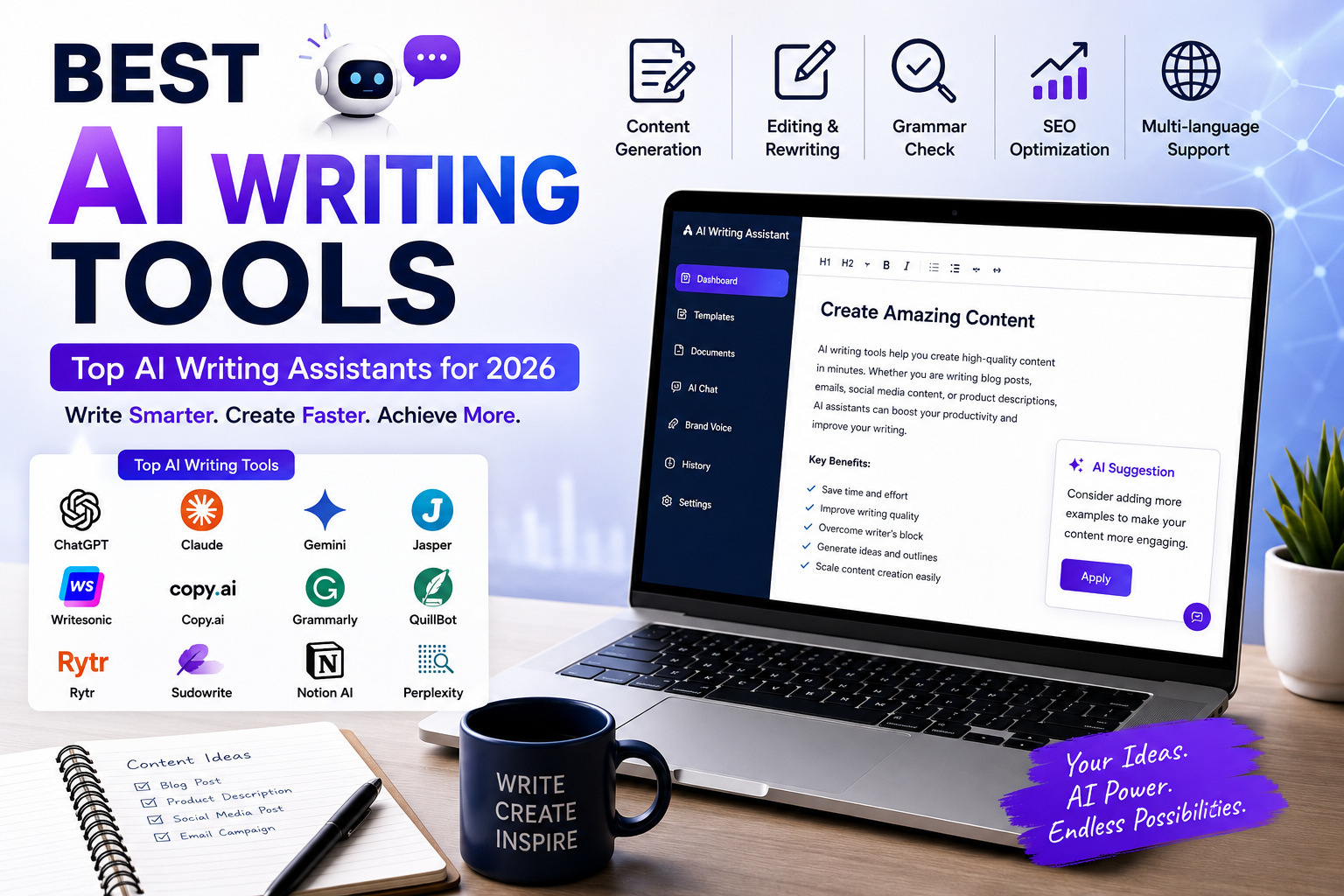
Best AI Writing Tools
Artificial Intelligence (AI) has transformed the way people create content. From writing blog posts and marketing copy to generating emails, social media captions, product descriptions, and business documents, AI writing tools are helping individuals and organizations save time while improving productivity.
Whether you’re a blogger, freelancer, digital marketer, business owner, student, or professional writer, the right AI writing assistant can streamline your workflow, overcome writer’s block, and improve content quality.
In this comprehensive guide, we’ll explore the best AI writing tools in 2026, compare their features, highlight their strengths and limitations, and help you choose the ideal solution for your writing needs.
What Is an AI Writing Tool?
An AI writing tool is software powered by advanced language models that can generate, edit, rewrite, summarize, and improve written content.
Most AI writing assistants can help with:
- Blog posts
- Articles
- Emails
- Product descriptions
- Website copy
- Landing pages
- Social media posts
- Advertising copy
- Business reports
- Technical documentation
- Creative writing
- Grammar correction
- Content translation
Rather than replacing human creativity, these tools assist writers by automating repetitive tasks and providing intelligent suggestions.
Benefits of AI Writing Tools
AI writing assistants offer significant advantages for content creators and businesses.
Save Time
AI can produce outlines, first drafts, summaries, and marketing copy within minutes, reducing the time spent on repetitive writing tasks.
Improve Productivity
Writers can focus more on research, creativity, and strategy while AI handles routine content generation and editing.
Overcome Writer’s Block
AI can suggest ideas, introductions, headlines, and transitions, making it easier to start and complete writing projects.
Better Grammar and Readability
Many AI writing tools improve grammar, spelling, punctuation, tone, clarity, and sentence structure, helping produce more polished content.
Support Multiple Languages
Several platforms offer multilingual writing, translation, and localization features, making it easier to create content for global audiences.
How AI Writing Tools Work
Although each platform uses different technologies, the general workflow is similar:
- Enter a prompt or writing request.
- Choose a writing style or template.
- Specify tone, audience, or desired length.
- AI generates a draft.
- Review, edit, and refine the content.
- Publish or export the final version.
Many tools also support collaborative editing, document organization, and integration with third-party applications.
How to Choose the Best AI Writing Tool
Before selecting an AI writing assistant, consider:
- Writing quality
- Ease of use
- SEO capabilities
- Grammar correction
- Content templates
- Collaboration features
- Language support
- Integrations
- Privacy and security
- Pricing
- Commercial usage rights
The best option depends on your specific goals, writing style, and workflow.
Best AI Writing Tools
Below are some of the leading AI writing tools available today.
1. ChatGPT
ChatGPT is one of the most versatile AI writing assistants, capable of generating high-quality content across many formats. It supports brainstorming, long-form writing, editing, coding assistance, and research support.
Best For
- Bloggers
- Freelancers
- Businesses
- Students
- Developers
Key Features
- Long-form content creation
- Blog writing
- Email drafting
- Brainstorming
- Content editing
- Code generation
- Research assistance
- Multi-language support
Advantages
- Highly versatile
- Strong reasoning capabilities
- Supports many writing styles
- Useful across multiple industries
Limitations
- Generated content should always be reviewed for accuracy and context.
- Some advanced capabilities may require a paid plan.
2. Claude
Claude is designed for thoughtful, detailed writing and is particularly useful for working with long documents.
Best For
- Long-form articles
- Technical documentation
- Business writing
- Content editing
Features
- Long-context processing
- Content summarization
- Rewriting
- Research assistance
- Document analysis
Pros
- Excellent handling of lengthy documents
- Clear, natural writing style
- Strong editing capabilities
3. Gemini
Gemini is an AI assistant that integrates with Google’s ecosystem and helps users create, edit, and refine content.
Best For
- Productivity
- Business communication
- Google Workspace users
Features
- Writing assistance
- Brainstorming
- Summarization
- Content generation
- Multilingual support
4. Jasper
Jasper is a dedicated AI content platform built primarily for marketers, agencies, and businesses.
Best For
- Marketing teams
- Agencies
- Brand content
- Advertising copy
Features
- Marketing templates
- Brand voice support
- Campaign creation
- SEO-friendly writing
- Team collaboration
5. Writesonic
Writesonic focuses on producing SEO-friendly articles, landing pages, advertisements, and website copy.
Best For
- SEO content
- Bloggers
- Copywriters
- Small businesses
Features
- AI article writer
- Landing page creation
- Product descriptions
- Blog outlines
- Marketing copy
Quick Comparison
| Tool | Best For | Long-form Writing | SEO Support | Grammar Assistance | Collaboration |
|---|---|---|---|---|---|
| ChatGPT | General Writing | Excellent | Good | Good | Yes |
| Claude | Long Documents | Excellent | Good | Excellent | Limited |
| Gemini | Productivity | Very Good | Good | Good | Yes |
| Jasper | Marketing | Excellent | Excellent | Good | Excellent |
| Writesonic | SEO Content | Excellent | Excellent | Good | Yes |
Why AI Writing Tools Are Becoming Essential
The demand for high-quality content continues to grow across blogs, websites, newsletters, social media, and digital marketing campaigns.
AI writing tools help users:
- Create content more efficiently
- Improve consistency
- Generate ideas faster
- Scale content production
- Enhance readability
- Support multilingual publishing
- Reduce repetitive writing tasks
When used responsibly, these tools can complement human creativity and increase overall productivity.
More of the Best AI Writing Tools
The AI writing landscape has expanded significantly, offering specialized tools for marketers, students, authors, SEO professionals, and business teams. Below are more leading AI writing assistants worth considering.
6. Copy.ai
Copy.ai is designed to help businesses create marketing copy quickly and efficiently.
Best For
- Marketing teams
- Sales professionals
- Startups
- Small businesses
Key Features
- Marketing copy generation
- Email writing
- Product descriptions
- Social media content
- Sales outreach templates
- Workflow automation
Advantages
- Easy to use
- Large template library
- Fast content generation
7. Grammarly
Grammarly is more than a grammar checker. It also helps improve clarity, tone, readability, and writing consistency.
Best For
- Students
- Professionals
- Business communication
- Academic writing
Features
- Grammar correction
- Spell checking
- Tone suggestions
- Readability improvements
- Style recommendations
- Plagiarism checking (on supported plans)
Advantages
- Excellent proofreading
- Easy browser integration
- Helpful writing suggestions
8. Rytr
Rytr is an affordable AI writing assistant suitable for beginners and freelancers.
Best For
- Bloggers
- Freelancers
- Entrepreneurs
- Small businesses
Features
- Blog generation
- Email writing
- Ad copy
- Social media captions
- AI rewriting
Pros
- Budget-friendly
- Beginner-friendly
- Simple interface
9. QuillBot
QuillBot specializes in rewriting and improving existing content.
Best For
- Students
- Researchers
- Editors
- Academic writers
Features
- Paraphrasing
- Grammar checking
- Summarization
- Citation assistance
- Writing enhancement
Advantages
- Excellent rewriting capabilities
- Multiple writing modes
- Easy document editing
10. Sudowrite
Sudowrite focuses on creative writing and storytelling.
Best For
- Novelists
- Screenwriters
- Fiction writers
- Creative professionals
Features
- Story generation
- Character development
- Dialogue suggestions
- Scene expansion
- Creative brainstorming
11. Notion AI
Notion AI combines document management with AI-powered writing and productivity features.
Best For
- Teams
- Project managers
- Businesses
- Knowledge management
Features
- Meeting notes
- Content drafting
- Task summaries
- Document organization
- AI editing
Advantages
- Strong collaboration
- Integrated workspace
- Productivity-focused
12. Perplexity
Perplexity is an AI-powered research assistant that combines conversational answers with cited information, making it useful for research-driven writing.
Best For
- Researchers
- Journalists
- Students
- Content creators
Features
- Research assistance
- AI search
- Summarization
- Source citations
- Follow-up questions
Feature Comparison
| Tool | Long-form Writing | SEO Features | Grammar | Templates | Team Collaboration |
|---|---|---|---|---|---|
| ChatGPT | Excellent | Good | Good | Limited | Yes |
| Claude | Excellent | Good | Excellent | Limited | Limited |
| Gemini | Very Good | Good | Good | Limited | Yes |
| Jasper | Excellent | Excellent | Good | Excellent | Excellent |
| Writesonic | Excellent | Excellent | Good | Excellent | Yes |
| Copy.ai | Good | Good | Good | Excellent | Yes |
| Grammarly | Limited | No | Excellent | No | Yes |
| Rytr | Good | Good | Good | Good | Limited |
| QuillBot | Limited | No | Excellent | No | Limited |
| Sudowrite | Excellent | No | Good | Creative | Limited |
| Notion AI | Good | Limited | Good | Good | Excellent |
| Perplexity | Good | Research-focused | Good | Limited | Limited |
Supported Writing Tasks
Modern AI writing tools support a wide variety of content types.
Blog Content
Suitable tools include:
- ChatGPT
- Claude
- Jasper
- Writesonic
Marketing Copy
Popular choices include:
- Jasper
- Copy.ai
- Writesonic
Academic Writing
Useful tools include:
- Grammarly
- QuillBot
- Claude
- Perplexity
Creative Writing
Recommended platforms include:
- Sudowrite
- ChatGPT
- Claude
Business Communication
Helpful tools include:
- Gemini
- Grammarly
- Notion AI
- ChatGPT
SEO Capabilities
For bloggers and website owners, SEO features are an important consideration.
Look for tools that help with:
- Keyword integration
- Meta descriptions
- SEO titles
- Blog outlines
- Readability improvements
- Heading structure
- Content optimization
While AI can assist with SEO writing, always review content manually to ensure it is accurate, useful, and aligned with search intent.
Productivity Features
Many AI writing assistants now include productivity tools beyond content generation.
Examples include:
- Document summarization
- Meeting notes
- Email drafting
- Task management
- Translation
- Brainstorming
- Workflow automation
These features make AI writing tools valuable for both individuals and teams.
Privacy and Security
If you work with confidential or proprietary information, evaluate each platform’s privacy and security practices.
Consider factors such as:
- Data handling policies
- Encryption
- User permissions
- Compliance certifications
- Enterprise security options
Avoid sharing sensitive personal information, passwords, API keys, or confidential business data unless you fully understand how the platform processes and stores your content.
Pricing Comparison
| Tool | Free Plan | Premium Available |
|---|---|---|
| ChatGPT | Yes | Yes |
| Claude | Limited | Yes |
| Gemini | Yes | Yes |
| Jasper | Trial or Limited | Yes |
| Writesonic | Limited | Yes |
| Copy.ai | Limited | Yes |
| Grammarly | Yes | Yes |
| Rytr | Yes | Yes |
| QuillBot | Yes | Yes |
| Sudowrite | Trial | Yes |
| Notion AI | Limited | Yes |
| Perplexity | Yes | Yes |
Pricing, usage limits, and included features can change over time. Review the latest plans on each provider’s website before subscribing.
Which AI Writing Tool Should You Choose?
The best AI writing tool depends on your primary use case:
- For blogging and long-form articles: ChatGPT, Claude, or Writesonic.
- For SEO-focused content: Jasper or Writesonic.
- For marketing campaigns: Jasper or Copy.ai.
- For academic writing: Grammarly, QuillBot, or Perplexity.
- For creative storytelling: Sudowrite.
- For business productivity: Notion AI or Gemini.
Rather than relying on a single feature, evaluate how well each tool fits your workflow, writing goals, collaboration needs, and budget.
Pros and Cons of AI Writing Tools
AI writing tools have become essential for bloggers, businesses, students, marketers, and professionals. While they can significantly improve productivity, they work best when combined with human creativity, expertise, and careful editing.
Advantages
- Generate content much faster than manual writing
- Help overcome writer’s block
- Improve grammar, spelling, and readability
- Produce multiple content formats from a single idea
- Support multilingual content creation
- Save time on repetitive writing tasks
- Assist with brainstorming and outlining
- Improve workflow efficiency for individuals and teams
Limitations
- AI-generated content may contain factual errors or outdated information.
- Human editing is essential for accuracy, originality, and tone.
- Some tools have limited customization in their free plans.
- AI cannot fully replace industry expertise, personal experience, or critical thinking.
- Output quality depends heavily on the clarity of the prompt.
Best AI Writing Tool by Use Case
There is no universal “best” AI writing tool. The right choice depends on your specific goals.
Best Overall
ChatGPT
Why choose it?
- Versatile content generation
- Excellent long-form writing
- Strong brainstorming capabilities
- Coding, research, and writing support
- Suitable for beginners and professionals
Best for Bloggers
Writesonic
Ideal for:
- SEO blog posts
- Content marketing
- Website articles
- Long-form publishing
Best for SEO Content
Jasper
Best suited for:
- Marketing agencies
- SEO professionals
- Brand-focused businesses
- Content campaigns
Best for Students
Grammarly and QuillBot
These tools help improve grammar, rewrite content, enhance readability, and support academic writing. They should be used responsibly and in accordance with your institution’s academic integrity policies.
Best for Businesses
Gemini and Notion AI
Useful for:
- Internal documentation
- Business communication
- Meeting summaries
- Team collaboration
- Workflow management
Best for Creative Writers
Sudowrite
Recommended for:
- Fiction
- Novels
- Storytelling
- Character development
- Dialogue writing
Best Free AI Writing Tool
ChatGPT
The free version provides strong capabilities for drafting, brainstorming, summarizing, editing, and learning, making it a practical starting point for many users.
Common Mistakes to Avoid
Using AI effectively requires thoughtful review and responsible editing.
Publishing Without Editing
Always proofread AI-generated content for:
- Accuracy
- Grammar
- Readability
- Brand voice
- Consistency
Ignoring Search Intent
If you’re creating SEO content, ensure the article genuinely answers the reader’s questions instead of simply repeating keywords.
Writing Weak Prompts
Detailed prompts usually produce better results.
Example:
Instead of:
“Write a blog.”
Try:
“Write a 2,500-word beginner-friendly SEO guide about email marketing for small businesses, using clear H2 and H3 headings, practical examples, and a professional tone.”
Forgetting Human Experience
Readers value personal insights, case studies, original examples, and practical expertise. AI-generated content becomes stronger when enriched with real-world knowledge.
Overusing AI
AI should assist your writing process—not replace creativity, critical thinking, or subject-matter expertise.
Tips for Better AI Writing
To produce higher-quality content:
- Write clear, specific prompts.
- Define your target audience.
- Specify the desired tone and structure.
- Fact-check important information.
- Add original examples and insights.
- Edit for clarity and flow.
- Optimize content for readability.
- Review before publishing.
Frequently Asked Questions
What is the best AI writing tool overall?
There is no single winner. ChatGPT, Claude, Jasper, Gemini, and Writesonic each excel in different areas depending on your workflow.
Can AI write complete blog posts?
Yes. AI can generate complete drafts, but human editing improves accuracy, originality, and overall quality.
Which AI writing tool is best for SEO?
Jasper and Writesonic provide features designed for SEO-focused content creation. ChatGPT can also support SEO writing when given detailed instructions.
Which AI writing tool is best for students?
Grammarly, QuillBot, ChatGPT, and Claude are commonly used for grammar improvement, summarization, and learning support. Students should always follow their institution’s academic integrity guidelines.
Can AI replace human writers?
AI can automate many writing tasks, but human creativity, judgment, storytelling, and expertise remain essential for high-quality content.
Is AI-generated content original?
AI generally produces new text based on patterns learned during training. However, originality, factual accuracy, and appropriate citations should always be reviewed before publication.
Are AI writing tools free?
Many platforms offer free plans with limited features. Premium subscriptions usually provide higher usage limits, additional models, collaboration tools, and advanced capabilities.
Can businesses use AI-generated content commercially?
Many providers allow commercial use under their terms of service, but you should review the latest licensing and usage policies before publishing or distributing AI-generated content.
Final Comparison Table
| Category | Recommended Tool |
|---|---|
| Best Overall | ChatGPT |
| Best for Bloggers | Writesonic |
| Best for SEO | Jasper |
| Best Long-Form Writing | Claude |
| Best Business Productivity | Gemini |
| Best Grammar Assistant | Grammarly |
| Best Paraphrasing | QuillBot |
| Best Creative Writing | Sudowrite |
| Best Team Collaboration | Notion AI |
| Best Research Assistant | Perplexity |
Final Verdict
AI writing tools have transformed the content creation process by helping users generate ideas, write faster, improve grammar, and streamline editing. Whether you’re a blogger publishing articles, a marketer creating campaigns, a student organizing research, or a business producing documentation, AI can significantly increase productivity.
However, the best results come from treating AI as a writing assistant rather than a replacement for human expertise. Reviewing facts, refining tone, adding original insights, and ensuring accuracy remain essential steps before publishing.
By selecting the tool that aligns with your goals and combining AI assistance with thoughtful editing, you can create content that is informative, engaging, and valuable to your audience.
Internal Links
- Best AI Image Generators
- Best AI Video Generators
- Best AI Coding Assistants
- Rank Math vs Yoast SEO
Conclusion
AI writing tools are changing how content is created across blogging, marketing, education, and business. They help users produce high-quality drafts more quickly, improve grammar and readability, and simplify repetitive writing tasks.
Despite these advances, successful content still depends on human judgment, creativity, and expertise. The most effective approach is to use AI for drafting and productivity while relying on careful editing, fact-checking, and original insights to deliver trustworthy, engaging content.
As AI continues to evolve, writers who combine these tools with strong writing skills and a clear understanding of their audience will be well positioned to create content that stands out in an increasingly competitive digital landscape.